
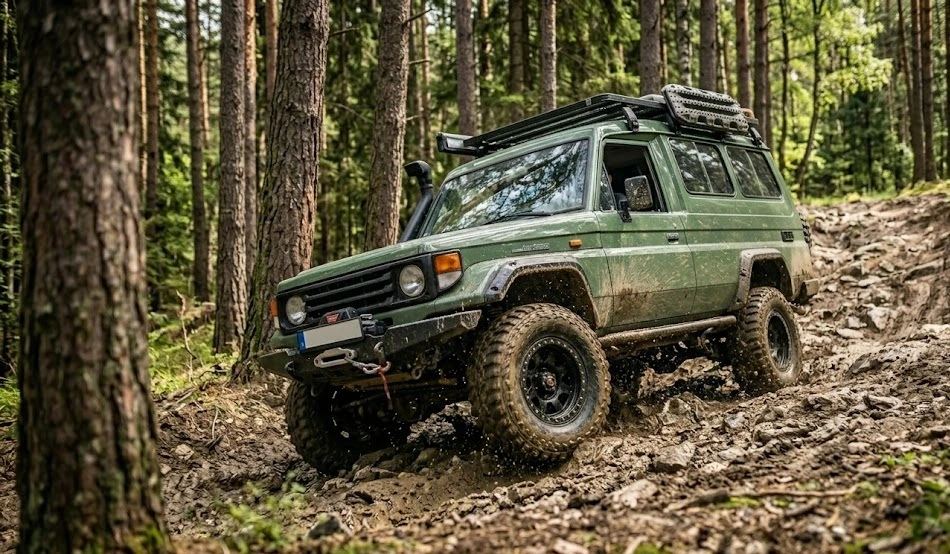
Choosing your first 4x4 depends entirely on your budget and goals. If you are looking for something lightweight that can go anywhere and is cheap to maintain, aim for a Suzuki (Vitara or Jimny). If you need a larger expedition vehicle for the family, versatile Japanese classics from Mitsubishi (Pajero) or Nissan (Patrol/Navara) make excellent starting points. For fans of modern American classics, a Jeep (Wrangler) or Ford (Ranger) is the perfect fit. At Expedition Gear, we provide the insights you need to choose wisely and avoid wasting money right out of the gate.
Three Hard Fast Rules Before Buying Your First 4x4
Before you fall in love with a specific vehicle from the classifieds, you must answer one crucial question: how will you actually use it? Leaving the pavement quickly separates expectations from reality. Here are the three factors that will determine your success:
- A Low-Range Transfer Case Is Essential: If you are serious about true off-roading, your vehicle must have a dual-range transfer case with low range. This extra gear reduction allows you to crawl slowly up steep inclines, drive through deep sand, and plow through mud without burning out your clutch or overheating the transmission.
- Spare Parts Availability: Out on the trail, suspension and drivetrain components inevitably wear out. Choosing a rare, exotic vehicle whose parts take weeks to ship from overseas will quickly ruin your weekends. Stick to popular brands so you can source replacements and accessories without a hitch.
- Body-on-Frame vs. Unibody: Classic off-road legends sit on a heavy-duty steel frame—making them nearly indestructible but heavy. On the other hand, modern SUVs or lighter 4x4s offer better comfort on the highway and perform exceptionally well for backcountry touring (overlanding), though they require smarter packing to avoid overloading the chassis.
The Best Brands and Models for Beginners – What to Choose?
There is no single perfect vehicle for everyone. We have broken down the most popular and cost-effective choices for beginners based on size and purpose:
- Suzuki (Jimny / Vitara): The absolute mountain goats. Thanks to their ultra-low weight, they can slip into places where rigs twice their weight get stuck. The Jimny features a brilliant body-on-frame design and solid front and rear axles. The downside? They are tiny. Packing for a week-long trip requires serious cargo gymnastics.
- Mitsubishi & Nissan (Pajero / Patrol / Navara): The Japanese school of survival. The Pajero is a fantastic, comfortable compromise for long expeditions, while the Patrol is an indestructible tank engineered for the harshest challenges. If you prefer mid-size trucks, the Navara provides a massive bed for long hauls.
- Jeep & Ford (Wrangler / Ranger): American styling meets a massive aftermarket modification ecosystem. The Wrangler is an off-road icon capable of tackling any trail or park right off the showroom floor. Meanwhile, the Ford Ranger stands as one of the top mid-size truck choices for overlanding—spacious, powerful, and incredibly versatile.
- Toyota & Land Rover (Land Cruiser / Hilux / Discovery): If your budget allows you to start at a premium level. These vehicles offer massive space, ultimate durability, and legendary status, but their initial baseline maintenance can put a significant dent in your wallet.
No Matter Your Choice of Rig – Cargo Box Physics Remains the Same
Did you pick up an agile Suzuki, a comfortable Jeep, a spacious Ford, or an expedition-ready Toyota? Congratulations! However, after your very first trail ride, you will notice one thing: the stock trunk or truck bed in any of these vehicles is simply an empty, unorganized space. Once you throw in recovery straps, shackles, a winch, a fridge, and groceries, the first set of bumps will unleash a loud, chaotic mess.
At Expedition Gear, we take a zero-compromise approach. Regardless of your vehicle's footprint, your gear needs to stay safe. We design our cargo drawer systems and side panels using heavy-duty, powder-coated steel and reinforced plywood. Unlike cheap plastic storage, a steel construction won't crack in sub-zero temperatures or bend when packed with heavy wrenches, shackles, or winch accessories. You get clean organization, mechanical drawer latches for steep climbs, and the peace of mind that nothing will fly forward if your vehicle tilts unexpectedly.
Prepare your first 4x4 cargo space:
| Lock Gear at the Bottom | Recovery Setup on the Sides | A Rugged Base on the Roof |
|---|---|---|
| Cargo Drawer Systems | Heavy-Duty MOLLE Panels | Roof Platforms |
| A rugged design built from steel and reinforced plywood. Heavy gear remains safely locked under the drawer deck, creating a flat load floor. | Laser-cut from steel and powder-coated. Ropes, axes, and first-aid kits are securely mounted by the windows—giving you fast access without digging through luggage. | Extremely durable steel platforms. The ideal, rigid foundation for a rooftop tent or additional expedition storage boxes. |
Time to Leave the Asphalt Behind!
Buying your first 4x4 is the start of an incredible journey. Don't look for the perfect do-it-all vehicle—choose the one that fits your budget and travel plans best. The most important thing is to start driving, connect with fellow enthusiasts, and learn trail physics through firsthand experience.
Once you make your choice and the vehicle is parked in your garage, don't leave cargo organization to the last minute before your trip.
Want to see what we have engineered for your rig? Head up to our main menu, click the [Select 4x4 Vehicle Model] button, and locate your brand. Whether you drive a Honda, Jeep, Ineos Grenadier, Ford, Land Rover, Suzuki, Isuzu, Lexus, Mitsubishi, Nissan, or Toyota—we offer heavy-duty steel solutions tailored precisely to the dimensions of your cargo space. Good luck with your purchase, and see you out on the trails!